|
Diarmaid Fleming
BBC
News |

The construction of a
motorway by the Irish Government through one of Ireland's most historic areas
has been condemned in a BBC Radio Ulster documentary, Tar on Tara, by the
country's foremost poet, Seamus Heaney, and other international experts.
|
The M3 motorway is well under construction through the lush
green and historical countryside of County Meath.
Ireland's biggest ever road project stretches 61km and is
expected to cost around 800m euros.
The motorway will take traffic north of Dublin, serving towns
such as Kells and Navan in County Meath, and counties Cavan, Fermanagh and
Donegal beyond.
Towns in Meath and Cavan are now home to thousands of people
working in Dublin many unable to afford to live there due to high property
prices in the Irish capital.
|
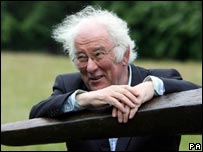
This is the poet's first broadcast interview on the
issue
|
Numerous new housing estates have sprung up in towns and
villages during Ireland's recent economic boom.
The speed of house-building has not been matched with investment
in transport however, meaning that all commuters are forced to rely on road
transport to get to Dublin. The area's only railway line is used for freight
only.
Best jams
The existing N3 road hosts the country's worst traffic jams
outside of Dublin, with trips between the city and Cavan 70 miles away taking
well over two hours and sometimes even longer during rush-hour.
Cars, trucks and buses snake in long lines through towns like
Dunshaughlin, choking them for hours in mornings and evenings.
The government decided a motorway was needed, with a new route
away from the existing N3 road, instead bringing it through an area which is
described by archaeologists internationally as the most important in Ireland and
of world significance.
The road under construction will run through the Tara Skreen
valley, an area which has been of historical and religious significance in
Ireland for thousands of years, with archaeological finds dating back to 4000BC.
The Tara complex is bounded by the Hill of Tara, seat of the
ancient High Kings of Ireland, and a place of sacred worship in both pagan and
Christian times.
 |
 If ever there was a place that deserved to be preserved in the name
of the dead generations from pre-historic times up to historic times up to
completely recently - it was Tara If ever there was a place that deserved to be preserved in the name
of the dead generations from pre-historic times up to historic times up to
completely recently - it was Tara 
|
Because the area represents such a long continuum of history -
compared to other world famous monuments such as Stonehenge covering a shorter
period of time - archaeologists say Tara is of extreme value in world terms.
Each generation has followed the next in their reverence for the
area, allowing archaeological experts to tell the story of civilisation in
Ireland, as well as historical and religious worship, through the messages in
its landscape and the artefacts left in its soil.
Neither the National Roads Authority (NRA) nor the Irish
minister for transport and local Meath TD Noel Dempsey were prepared to be
interviewed for the documentary.
The NRA has said however, that the road was chosen after public
consultation, and that its choice was influenced by a range of factors it has to
consider, of which archaeology is only one.
Other factors such as the need to demolish homes, and to go
through environmentally sensitive areas also had to be taken into account, the
authority says.
But critics say that the area, because of its unique sacred and
historical importance, should never have been contemplated as the route for the
road in the first place.
'Ruthless'
Seamus Heaney in his first broadcast interview on the subject,
told BBC Radio Ulster that the plan was a "ruthless desecration".
"I think it literally desecrates an area - I mean the word means
to de-sacralise and for centuries the Tara landscape and the Tara sites have
been regarded as part of the sacred ground," he said.
"I was just thinking actually the Proclamation of the Irish
Republic in 1916 summoned people in the name of the dead generations and called
the nation, called the people in the name of the dead generations.
"If ever there was a place that deserved to be preserved in the
name of the dead generations from pre-historic times up to historic times up to
completely recently, it was Tara."
The Nobel Laureate also said that under British rule in Ireland,
Tara appeared to have more protection than in today's Irish Republic.
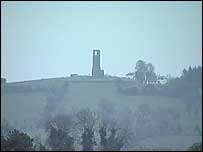
TWork on the 800m euro project is already well under
way |
He said: "I was reading around recently and I discovered that WB
Yeats and George Moore, two writers at the turn of the century and Arthur
Griffith, wrote a letter to the Irish Times sometime at the beginning of the
last century because a society called the British Israelites had thought that
the Arc of the Covenant was buried in Tara, and they had started to dig on Tara
Hill.
"And they wrote this letter and they talked about the
desecration of a consecrated landscape. So I thought to myself if a few holes in
the ground made by amateur archaeologists was a desecration, what is happening
to that whole countryside being ripped up is certainly a much more ruthless
piece of work."
Mr Heaney said that the Celtic Tiger was attacking the ancient
symbol of Ireland, the harp.
"It will be a sort of signal that the priorities on these
islands have changed, I mean the Tiger is now lashing its tail and smashing its
way through the harp - the strings of the harp are being lashed by the tail of
the tiger," he said.
Heaney said that Tara was unique to him as an Irishman.
"Tara means something equivalent to me to what Delphi means to
the Greeks or maybe Stonehenge to an English person or Nara in Japan, which is
one of the most famous sites in the world," he said.
"It's a word that conjures an aura - it conjures up what they
call in Irish dúchas, a sense of belonging , a sense of patrimony, a sense of an
ideal, an ideal of the spirit if you like, that belongs in the place and if
anywhere in Ireland conjures that up - it's Tara - it's a mythical site of
course.
"I mean the traces on Tara are in the grass, are in the earth -
they aren't spectacular like temple ruins would be in the Parthenon in Greece
but they are about origin, they're about beginning, they're about the
mythological, spiritual source - a source and a guarantee of something old in
the country and something that gives the country its distinctive spirit."
|
It was a government which decided that these monuments would be
erased and cultural erasure is part of the game of war and buildings very often
suffer from that
|
Tara has been placed by the New York-headquartered World
Monuments Fund (WMF) on its list of the world's 100 most endangered sites.
WMF UK chief executive Dr Jonathan Foyle was scathing of the
Irish government's actions in routing the motorway through the valley, saying it
ranked with the actions of the Taleban regime in Afghanistan.
"The World Monuments Fund watch list contains all sorts of
endangered sites - this one actually reminds me of the Bamiyan Buddhas which
were destroyed by the Taleban in 2001 against international uproar," said Dr
Foyle.
"It was a government which decided that these monuments would be
erased and cultural erasure is part of the game of war and buildings very often
suffer from that.
"It's scarcely more creditable to say we will destroy a building
which is of equal significance to the Bamiyan Buddhas - let's face it, this
entire site is the equivalent of Stonehenge, Westminster Abbey for its royal
associations, Canterbury for its Christian associations - all rolled into one."
Hundreds of academics, archaeologists and conservationist from
around the world have written to the Irish government to register their
opposition to the M3 route.
Twenty-seven members of the European Parliament have written to
the government also, after a visit to the area by some resulted in a highly
critical report of the project.
Legality
The European Commission is considering legal action against the
Irish government which granted itself the powers in 2004 to destroy features or
areas of archaeological importance classified as national monuments if in the
national interest.
These powers were granted after the government lost a battle in
the Irish Supreme Court against archaeological campaigners over the destruction
of another monument during the construction of part of the M50 motorway in
Dublin.
A national monument at Lismullen close to Tara was discovered
last year when an ancient "henge" or ceremonial temple was unearthed in the
route of the M3 on 1 April, and then destroyed after its features were recorded.
While experts agreed the henge remnants could not be preserved
once exposed, the European Commission is considering legal action over the
European legality of Irish law relating to the powers the government has granted
itself to destroy national monuments.
However, any action will not stop the road, well under
construction by Irish and Spanish joint-venture SIAC Ferrovial, and expected to
be completed within two years.
While Irish government politicians and supporters of the
motorway such as business organisations frequently claim the road - and not the
archaeologists - have the support of the majority of people, a recent opinion
poll suggests the opposite. A national poll by Red C Research said that 62%
opposed the route of the road, almost double the 32% in favour.
But whatever the views now, those who want to see the motorway
come to Tara have won the day.
Future generations studying Tara will see the 21st century's
major contribution to an area charting thousands of years of civilisation in
Ireland was the new M3 motorway and its associated development.
Tar on Tara is broadcast on BBC Radio Ulster at 1430 GMT on
Sunday 2 March.
Radio Ulster Documentary - 1st March 2008 - play - 
|