Anois teacht an Erraigh,
beidh an lá dul chun síneadh,
is tar éis
la Féile Bríde
ardóidh mé mo sheol.
Now that the spring has
come,
the days will grow longer,
and after (Saint) Brighid's feast
day
I will hoist my sail.
IMBOLC/OIMELC
By Ellen Evert
Hopman
(La Fheile Bride, Ireland, Gwyl Mair Dechraur Gwanwyn,
Wales,
Laa'l Breeshey, Isle of Mann, Goel Kantolyon, Brittany)
Moch
maduinn Bhride, thig an nimhir as an toll;
Cha bhoin mise ris an nimhir, Cha
bhoin an nimhir rium.
Early on Bride's morn, the serpent will come from
the hollow;
I will not molest the serpent, nor will the serpent molest
me.
THE FEAST DAY OF BRIGHID
Saint Brighid is one of the best
known and most venerated of
Celtic saints. She has been given many titles;
The Lady of the
Isles, Bride of the Mantle, Gentle Shepherdess, Guardian of
the
Cattle, Protector of the Newborn, Nursemaid to the Sick, Midwife
of
Mary and Mary of the Gael. Saint Brighid was said to have been
reared
on the milk of a white cow with red ears, the typical
colorations of a Celtic
otherworld beast. She was said to possess
a girdle that could heal all
disease.
But long before Brighid the saint there was another Brighid,
one
whose identity and feast day (February 2) were gradually subsumed
by
the later historical figure, a Goddess who was known as
Brighid in Ireland,
Bride in Scotland and Brigantia in Britain.
Daughter of the Daghda, She was a
Triple Goddess, said to always
appear as three sisters, each named Brighid.
Her spheres of
influence were poetry, smithcraft and healing. She was
the
Patroness of the Druids and Bards. The Brigantes, a British
Celtic
tribe, honored Brigantia as "The High One" and "Mother of
the
Gods". She was the most prominent pan-Celtic female deity.
Brighid
was especially associated with healing wells and springs,
and with sacred
fire. As Brigantia she was especially concerned
with the flocks and herds and
with the produce of the earth. These
spheres were later taken up by Saint
Brighid of Kildare, patroness
of numerous holy wells, whose fire temple was
tended by nine
maidens until the Pope declared it heretical and shut it down.
(The
perpetual fire of Brighid has recently been re-lit by nuns in
Ireland
and women across the globe are once again tending fires in
Her
name).
Brighid's sacred bird was the Oystercatcher, "giolla
Bride"
(Irish, Brighid's servant) and "Brideun" (Scots Gaelic,
Brighid's
bird) which was said to guide people who were under her
protection.
Her mother was Boann, Cow Goddess of the White Moon and Goddess
of
the Boyne river in Ireland, making cows her sacred animals. She
was
also associated with the white mare, the serpent, and red eared,
white
bodied hounds who guide travellers to the Otherworld.
Imbolc is Brighid's
own festival, one of the four great Celtic
Fire Festivals along with Samhain
(summers end), Beltaine (Fires of
Bel, summers beginning) and Lughnasad (the
first fruits festival
inaugurated by the God Lugh in honor of his foster
mother at her
funeral games). It marks the midpoint of the dark half of the
year.
It also marks the beginning of the lactation of the ewes, an
all-
important milk festival of the ancients. The name of the festival
may
derive from m(b)lig, "milk" or the Old Celtic Ouimelko, "ewes
milk"
.
Along with the streams of new milk Imbolc marks the time when
other
steams of life are re-kindled in the land - forest animals
begin their mating
rituals and serpents begin to stir in their
lairs. Farmers test the soil to
see if it is thawed enough for the
first plowings and snowdrops spring up in
the spots where Brighid's
feet have trod.
At this time the Hag of
Winter, the Cailleach, who has ruled
since Samhain visits the Well of Youth.
At dawn on the day of the
festival she drinks from the Well of Youth and her
face is
transformed from haggard old age to the serene and youthful face
of
Brighid. For this reason Brighid is sometimes called The Maiden of
the
Rising Sun.
The Cailleach carries a Druid Wand of great power, a white
rod or
slachdan made of birch, willow, bramble or broom. With its
magic
powers She controls the elements and the weather. Brighid carries
a
white rod too but where the Cailleach's rod brings storms and
harsh weather,
Brighid's brings warm winds and new life.
It was said that where Brighid
walked over the waters or touched
them with her finger the ice melted. And
that the land turned green
where she spread her mantle upon it, or when she
breathed upon the
hills. Families would leave a mantle or a cloth outdoors on
the eve
of the festival to be blessed by the sun and by Brighid on
Imbolc
morn. The mantle was later used to cover the sick and the
cloth
would be cut into strips to be tied onto a sick person or
animal
throughout the remaining year.
PURIFICATION BY FIRE AND
WATER
Imbolc celebrates the re-kindling of the fires in the earth
which
give life and movement to plants and animals. Seeds burst open,
sap
rises and animals begin their mating rites. The fire in the sun
begins
to wax noticeably. Imbolc marks the time when it is no
longer necessary to
carry a candle to do the early morning chores.
Candles are left burning on
windowsills all night to mark the
seasonal passage.
Brighid's
blessings are invoked on the forge and on the tools of
the smith, and also on
agricultural implements and the plow, the
product of the smith's
transformative art. Smith craft is potent
magic, the ability to fashion
metallic ore into bronze or iron. It
is directly under the sanction of
Brighid.
To this day in Ireland there are numerous holy wells dedicated
to
Brighid. The ancient Celts marked the beginning of each
agricultural
cycle by purifying themselves with water. The feet,
hands and head were
ritually washed and who better to bless the
waters than Brighid Herself? Fire
and water were seen as the
building blocks of creation, the basic foundations
for all
transformative magic. By invoking a Fire Goddess into the
waters
the stage was set for growth and change.
THE SOLAR CROSS OF THE
GODDESS
Equal armed solar crosses (a design that long
predates
Christianity) were plaited from rushes to bring luck to the
home.
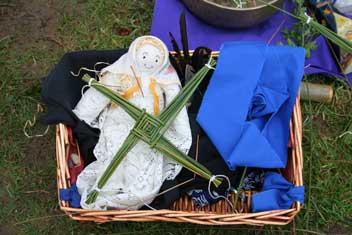
In the Western Isles of Scotland the women dressed a doll, named
her
Brighid, and placed her in a reed basket. On Imbolc Eve, at
sunset, they
circled the house three times sunwise, carrying the
basket and moved from
house to house carrying Brighid's crosses and
lit candles to every home in
the village.
In parts of Ireland the eldest daughter of the house
gathered
rushes and brought them home where she was formally welcomed by
the
family as a representative of Brighid. The girl would then
move
through the house blessing the home, the food and drink within
it,
and especially the hearth.
A solar cross shaped bread was placed
on top of the rushes to be
eaten later or crumbs from the cross shaped bread
were strewn on
the rushes. The whole family participated in the making of
Crosoga,
equal armed crosses that were hung in the home and placed
in
windows. Rushes might be left by the fire overnight, covered by a
white
cloth, as a "Bride's Bed". The Goddess was invited to sleep
there overnight,
thus empowering the rushes with Her healing
strength.
Any left over
rushes were used for healing work throughout the
year. They could be tied to
the horns of cattle as protection or
fastened to the handle of the churn to
prevent hexing of the milk.
They could also be tied around an ailing limb or
placed around the
neck of one who was ill.
A Crios Bride, a hoop of
staw with four solar crosses tied to it,
was carried from home to home. Men
would step through it and women
would lower it over their heads and step
through it three times to
mark a ritual "rebirth".
In some areas a
Brideog, a straw doll wearing childs clothing,
would be carried from house to
house by young girls who sang and
recited prayers at every door where they
were given small gifts in
exchange. Often the girls would meet at the last
house for a party
with music and dancing.
Sometimes a single woman was
chosen to carry a solar cross from
door to door. She was understood to be the
representative of
Brighid, bringing blessings to each household. In Munster
and
Connacht the procession was composed entirely of men, dressed in
white
skirts and with conical straw masks over their heads.
SNAKES AND
HEDGEHOGS
The festival of Imbolc marks the true origins of Groundhog
Day.
In Scottish tradition a snake was said to emerge from its mound,
its
motions and behavior determining the remaining days of frost.
If the snake
became active a thaw was immanent. If it returned to
its nest a month more of
winter was to be expected.
The serpent was an ancient symbol of the
powers of the earth and
of the spirit that motivates the forces of growth,
decay and
transformation. As the serpent shed its skin it illustrates
the
eternal powers of renewal inherent in the land. Snakes were also
a
symbol of healing. Pictish stone carvings often depict
sacred
snakes.
In Ireland it was the hedgehog who made an Imbolc
appearance and
in the modern United States it is the ground hog who carries
on the
tradition.
TRADITIONAL FOODS AT IMBOLC
To celebrate the
lactation of the ewes, butter was a traditional
addition to any Imbolc dish.
Cake, bread, butter or porridge would
be placed in the window and left as an
offering for Brighid's white
cow, with whom She travels. The next morning
these foods blessed by
Brighid were eaten by the household or shared with the
needy. Straw
or fresh rushes would be left on the doorstep overnight as well,
in
hopes that the Goddess would stop there and bless the home. Butter
left
out on Imbolc night would be saved to make healing salves and
ointments later
in the season.
Colcannon
Chop and shred a white cabbage and cook
until tender. Steam eight
medium potatoes and pass through a food mill or
boil until soft and
mash in a hot pan. Chop a bunch of scallions and simmer
lightly in
1 1/2 cups milk for five minutes. Beat the scallions into
the
mashed potatoes until smooth and fluffy. Fold in the cabbage. Add
salt
and pepper to taste. Serve with a large lump of butter melting
on top and a
glass of cold milk. (This dish is also traditional
at
Samhain).
Dandelion Salad
Dandelions, with their yellow
solar flowers and their milky white
sap are sacred to Brighid. Dandelions
first bloom at the time of
Brighid's festival and their greens make a
healthful early spring
dish. The roots are medicine for the liver and the
flowers are used
to make a yellow wine.
Soak the new greens and
freshly grated roots for twenty minutes
in cold water with 2 tbsp vinegar
added to remove possible
parasites. Rinse thoroughly and toss lightly with
lemon juice,
olive oil and sea salt. Try adding slivered onions, grated
carrot,
baby lettuce, violet leaves and flowers or spinach. Top with
grated
garlic or nutmeg, or grated lemon peel for variety.
Add dandelion
greens to soups or boil the greens like spinach.
Blackberry Wine and
Jelly
The blackberry is another herb sacred to Brighid. Its leaves
are
used to poultice wounds and burns and its roots are made into a tea
to
cure diarrhea. Crawling under a blackberry bush was once
regarded as a potent
charm against rheumatism, boils and
blackheads. The whole plant was valued as
a charm against disease.
Blackberry pies, jams, jellies and wines can be
added to the feast
in Brighid's honor.
Bonnach Bride
In
Scotland a bonnach Bride or bannock of Bride was made at
Imbolc, a bonnach
Bealltain at Beltaine, a bonnach Lunastain at
Lughnasad and a bonnach
Samthain at Samhain. In each case a large
cake was baked for the family and
smaller cakes for each family
member. The family walked out into the fields
to eat the cakes,
throwing a piece over each shoulder and offering it to
dangerous
spirits who might harm the fields and flocks such as wolf,
fox,
eagle, hawk, martin and raven. The cakes and breads used in this
way
featured hidden fruits and nuts.
Barm Brack
Cream 1 tsp yeast with
1 tsp sugar and allow to froth up in 1 1/2
cups warm (not hot) milk. In a
separate bowl sieve 2 cups flour, 2
tsp powdered sugar and 1 tsp allspice.
Cut in 3 tbsp butter. Make
a well in the center and pour in the yeast and
milk mixture and one
beaten egg. Stir with a wooden spoon for about 10
minutes. Work in
a pinch of salt and 2 cups of mixed fruits (currants,
raisins,
candied peels, etc.). Knead well.
Place in a warm bowl, cover and
allow to rise for about an hour
or until doubled in size.
Knead lightly
and place in a greased 7 inch cake pan. Allow to
rise 1/2 hour more. Bake at
400 degrees for 45 minutes. Upon
removal from the oven glaze with a syrup
made with 2 tsp sugar
dissolved in 3 tsp boiling water.
Porter
Cake
Melt 1 cup butter and 1 cup brown sugar in 1 cup Porter (a
type
of dark ale) in a saucepan. Add 6 cups of mixed fruit
(currants,
raisins, slivered almonds, about half as much mixed candied
peel)
and simmer for 10 minutes. Allow to go cold and add 4 cups
sieved
flour, 1/2 tsp baking soda, 1 tsp grated lemon zest, and 1
tsp
allspice. Beat 3 medium eggs and fold in with a wooden spoon.
Pour
into a greased 9 inch cake pan and bake in a pre heated oven
at 325 degrees
for about 1 3/4 hours. Test with a skewer until the
skewer comes out clean.
Allow cake to cool in the tin.
Crepes
In Brittany the ubiquitous crepe
is the traditional festival
dish.
THE FAIRIES AT IMBOLC
On the
eve of every quarter feast (Samhain, Imbolc, Beltaine,
Lughnasad) the fairies
are said to move from one Fairy Hill to
another. Those with "the sight"
should be able to easily observe
them. A witch can be detected on the first
Monday of each quarter
because the smoke from her chimney will blow AGAINST
the wind.
All of this and much more can be found in my newest tree
book;
A Druid's Herbal of Sacred Tree Medicine!
Ellen
|